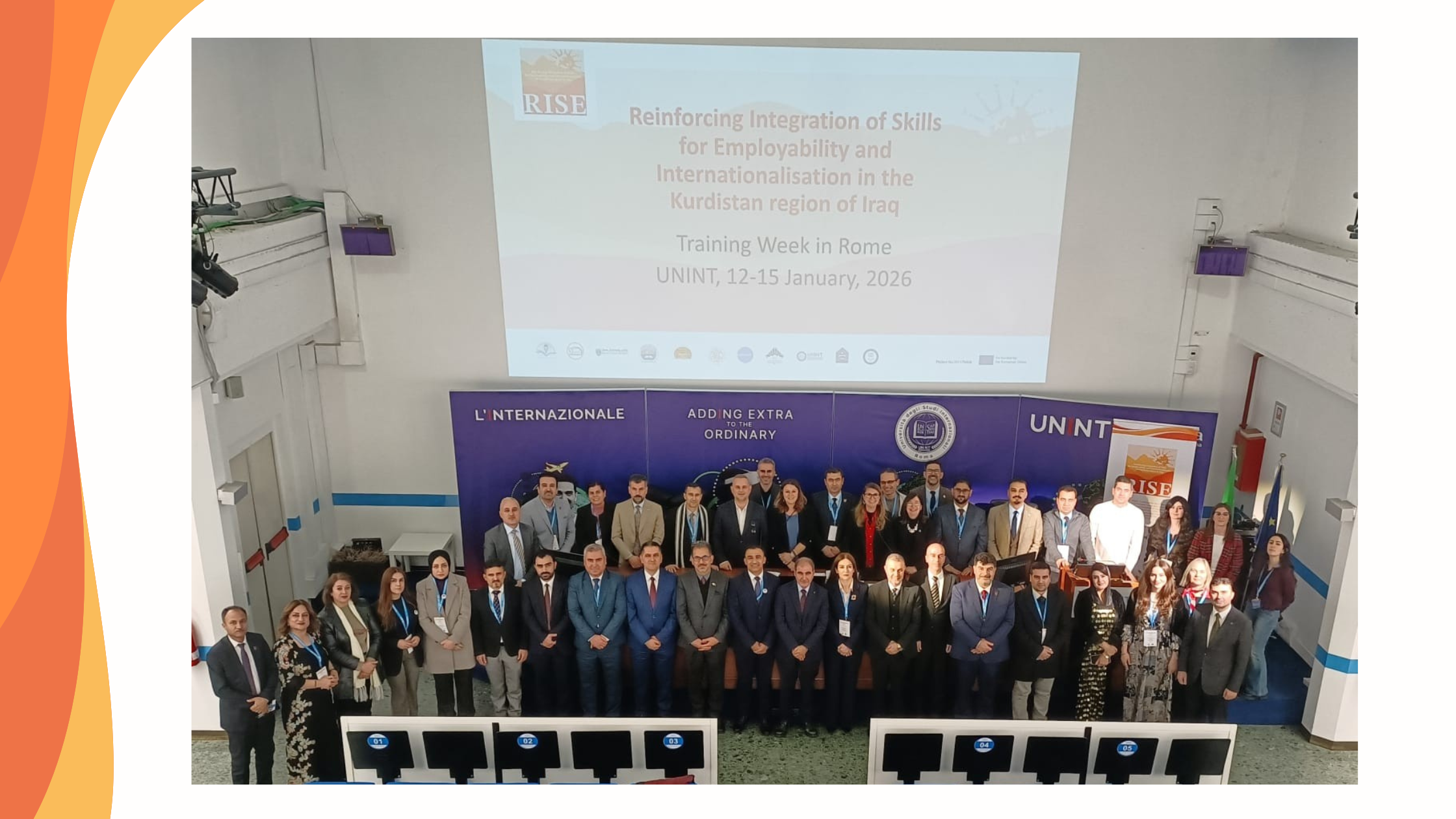
Rome, 12–15 January 2026 —The 2nd RISE Training Week took place in Rome, hosted by the International University of Rome – UNINT, bringing together 35 representatives from International Relations Offices (IRO) and Career Development Centres (CDC) of partners universities in the Kurdistan region of Iraq to continue the RISE capacity building activities, building on the momentum of the 1st training week in Murcia.
Day 1: Opening session, internationalisation and institutional exchanges
The opening session featured high-level speakers, willing to kick-off the week in the best possible way. They stressed the relevance of such occasions to foster direct dialogue and staff-to-staff exchange, to enforce internationalisation and cooperation across borders, and highlighting the value of the project approach. In particular:
- Mariagrazia Russo, Rector of UNINT, reaffirmed the University’s commitment to strengthening cooperation with Kurdistan region of Iraq universities through sustained institutional partnerships.
- Diary Ahmed Majid, Head of Mission and Chargé d’Affaires ad interim (Minister Plenipotentiary) of the Embassy of Iraq in Italy, highlighted how initiatives like RISE are vital to enhancing institutional engagement and fostering partnerships that contribute to economic growth, social cohesion, and stability.
- Silvia Marchionne, RISE Project Coordinator and UNIMED Senior Project Manager, noted that the training week further confirms how internationalisation and employability and their synergies are increasingly central to the mission of higher education institutions.
The second part of Day 1 moved into the programme’s core themes. Eva Saeva, Italian National Agency Erasmus+ INDIRE, provided an overview of Erasmus+, focusing on CBHE and ICM projects and the opportunities they open—particularly for cooperation with the Middle East. Building on this, Elisa Petrucci, CIMEA, highlighted the growing relevance of international qualification recognition as a tool to enable mobility and strengthen trust between higher education systems.
A roundtable moderated by Luciano Nieddu, UNINT Vice-Rector for Internationalisation, brought the discussion into practice presenting the experiences of 4 Italian universities, International University of Language and Media – IULM, Università degli Studi Guglielmo Marconi, Alma Mater Studiorum – Università di Bologna, and Università di Pisa, showcasing how institutional strategies are shaping the future of higher education internationalisation, career guidance and transnational collaboration in education and research.
Day 2: From strategy to practice. IRO structures, mobility and innovation
Day 2 focused on operational practice in internationalisation of higher education. Sessions opened with a presentation on Comprehensive Internationalisation as a framework for institutional development—linking international activities to governance, services, partnerships, and long-term impact—led by Silvia Marchionne and Martina Zipoli, UNIMED Senior Project Managers.
Participants then went “behind the office doors” with a deep dive into UNINT’s International Relations Office: structure, mission, responsibilities, and workflows, presented by Federica De Matteo, UNINT International Relations Coordinator. A specific focus on International Credit Mobility (ICM) was explored with Domitilla Luciani, UNINT International Relations Officer.
The day also closed with a seminar with Ahmad Adamat, Head of International Relations and Agreements Division at Al al-Bayt University (AABU), Jordan, illustrating how IRO offices can effectively support partnerships and broader institutional internationalisation strategies. The sessions concluded with a presentation on Digital Transformation and Employability, with Prof. Abualigah Laith (AABU), offering a roadmap to integrate AI strategically and responsibly into internationalisation and employability planning.
Both focused on concrete examples and sharing experience from a Jordanian university, offering the opportunity for the partner universities to exchange, dialogue, compare and build possible South-South collaboration.
Day 3: Student-centred internationalisation
Day 3 highlighted how internationalisation becomes tangible when it is inclusive, accessible, and student-centred. Two UNIMED sessions set the tone: Internationalisation at Home, presented by Anne-Laurence Pastorini, Senior Project Manager and Sustainability as a global opportunity for academic internationalisation, presented by Nathalie Clauter, Senior Project Manager, reinforcing how international perspectives can be embedded into everyday learning and institutional culture.
UNINT staff then shared concrete practices, including:
- Fair recognition practices with Luciano Nieddu, promoting transparent and equitable recognition of learning experiences;
- Student support services, including the Buddy Programme, presented by Federica De Matteo, as a tool for inclusion, integration and peer learning;
- Language skills development with Giulia Di Vito, University Language Centre Coordinator, positioning language as a key enabler for participation and international opportunities.
The day also included an exchange with UNINT’s CDC, focusing on employability and internationalisation through career guidance and links to the labour market, presented by Manuela Costa, Placement Office Coordinator.
The programme concluded with a cultural moment and guided visit to St Peter’s Basilica.
Day 4: One shared direction — roadmaps, student voices and next steps
On the final day, participants connected strategy to impact through the presentation of the Synergic Roadmap for Internationalisation & Employability, co-built from the roadmaps developed by partner universities in the Kurdistan Region of Iraq—one shared direction shaped by many voices.
The day also placed students at the centre, highlighting the UNIMED initiatives that strengthen student engagement across the network—Start Cup Competition, the Mediterranean Students Summit, and the UNIMED Venice Award—and featuring testimonials from two incoming ICM students sharing their experience at UNINT, from Jordan and from Montenegro, and one from an outgoing student that travelled from Italy to Morocco. The students’ testimonials all delivered the same message: mobility is beneficial beyond all expectations, both professionally and personally, and it provides unique opportunities for self-development and for building long-lasting connections.
In conclusion, the seven Kurdish partner institutions worked on developing ideas and outlining concrete pilot actions to implement their strategic roadmaps in the coming months. During a dedicated working group, institutions were asked to reflect on possible pilot actions to be implemented in the coming months, applying the Synergic approach of the synergic roadmap.
When institutions collaborate with purpose, internationalisation becomes opportunity—and employability becomes reality. Follow us for the next steps!